[Problem]
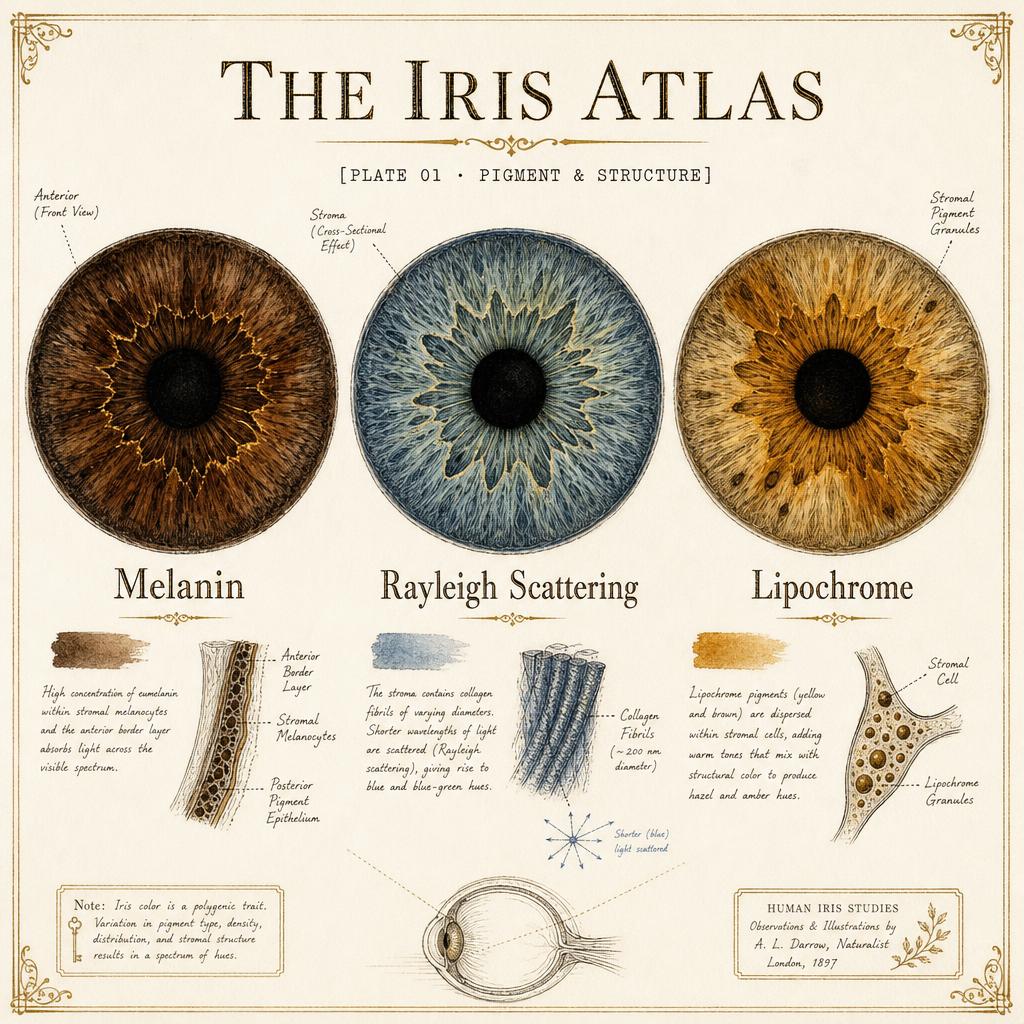
Eye color is usually flattened into six crayon-box labels. Neither the pigment science (melanin, lipochrome, stromal scattering, limbal rings, central heterochromia) nor the folklore and symbolism that wrap each iris had a single surface where they sat side by side.
[Approach]
- 01Designed a pigment vector that a reader can either hand-tune or derive from a photo upload, then score against the full human eye-color spectrum.
- 02Built iris feature detection and a viewing-context model so the same eye can be read across different lighting and backgrounds.
- 03Added an optional birth-chart pairing so the symbolic layer can sit next to the biological one without either crowding the other out.
[Outcome]
An interactive atlas that doubles as a serious reference tool and a piece of editorial writing about how we read each other's eyes.
[Background]
The Iris Atlas lets a reader either upload a photo or hand-tune a pigment vector — melanin, lipochrome, stromal scattering — to find their match across the full human eye-color spectrum. Each match opens into the science of how that color forms and the symbolism, folklore, and spiritual meaning attributed to it.
The project layers in iris feature detection (limbal rings, central heterochromia, sectoral patterning), a viewing-context model for how the same eye reads in different light, and an optional birth-chart pairing for readers who want the symbolic layer to sit next to the biological one. Built as a serious reference tool that still reads like a field guide.